New Album EnTangled
Entangled, the latest project by BOI AKIH (Monica Akihary – vocals, Niels Brouwer – guitar), is not written for a single fixed ensemble. Instead, it is conceived as flexible music that can be performed in many different constellations. The project has so far been presented in a large ensemble setting with woodwinds, brass, cello, and drums, as well as in more intimate formats, such as a quartet with organ and modular synthesizer, and in its smallest form as a duo. In this latter form, BOI AKIH recorded their new album, to be released by ENJA Records in May 2026.
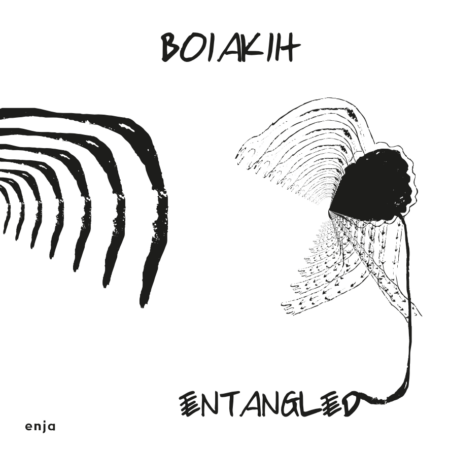
“The seed for Entangled was planted two years ago in Tuni, a small mountain village on Ambon, during a collaboration with the Moluccan Bamboowind Orchestra (MBO). One day, a flute player failed to show up for a rehearsal. When asked why, he explained that he had gone to collect honey, was stung so badly that he had to sleep for two days and chose not to take precautions—because doing so would mean taking too much honey and harming the bees. That story stayed with me”.
Later, when I read about proposals to combat global warming by building factories that remove carbon dioxide from the air, I was reminded of that moment in Tuni. If we manage to remove carbon from the air, we will probably end up producing even more, which would lead to even more factories — a nightmare scenario. Forests and trees already perform this function naturally breathing in carbon, offering shade, beauty, and life. That quiet contrast became the starting point for this music.
When I began composing in early 2025, it became increasingly clear that the music was really about interdependence — the sense that all things are connected. This idea became the central concept of Entangled. The music needed to exist as a single, continuous piece, in which all parts, though very different, remain deeply connected. It also needed to be global in spirit, because the subject concerns us all. All performers should actively contribute to shaping the music, sharing collective responsibility.
With these ideas in mind, I wrote the first themes. Initially, I imagined the piece as a duo for Monica and myself, but a project with a larger ensemble—drums, cello, brass, and bass clarinet—was already planned. I decided to rework the material for this extended lineup. Writing for more instruments forced me to think beyond the intimacy of voice and guitar and pushed me to write more melodic material. That process clarified the music and shaped it in a wonderful way. After performing these concerts, we returned to the duo format—and suddenly everything fell into place. I am deeply happy with the result and look forward to performing this music in many different formations. For me, the essence lies in the people involved—their input, their presence, and the shared energy between musicians. That collective vibe is what gives music its true magic.
I think of the piece as a journey through interconnected sonic worlds, a single continuous form where smaller arcs of tension emerge and dissolve within a larger structure. Moments of song-like clarity appear, only to dissolve back into more abstract melodic and rhythmic landscapes
In contrast to the acoustic universe created by the voice and seven-string classical guitar, electroacoustic sounds enter and surge — sometimes caressing, sometimes clashing — reshaping the music in ways I can’t always predict.
For me, this music exists in the space between composition and improvisation. Spontaneity fuels its urgency and intensity, while an underlying structure keeps it grounded. I draw freely from many musical styles, yet the music never submits to them; instead, I reshape them, allowing them to transform into something entirely new — something that belongs to the moment of creation itself.
Niels Brouwer

